trends
PlantDemand × Asphalt Operations: A Collaborative Approach to Upgrading Sales Scheduling and Raw Material Planning at Asphalt Plants
2026-06-05
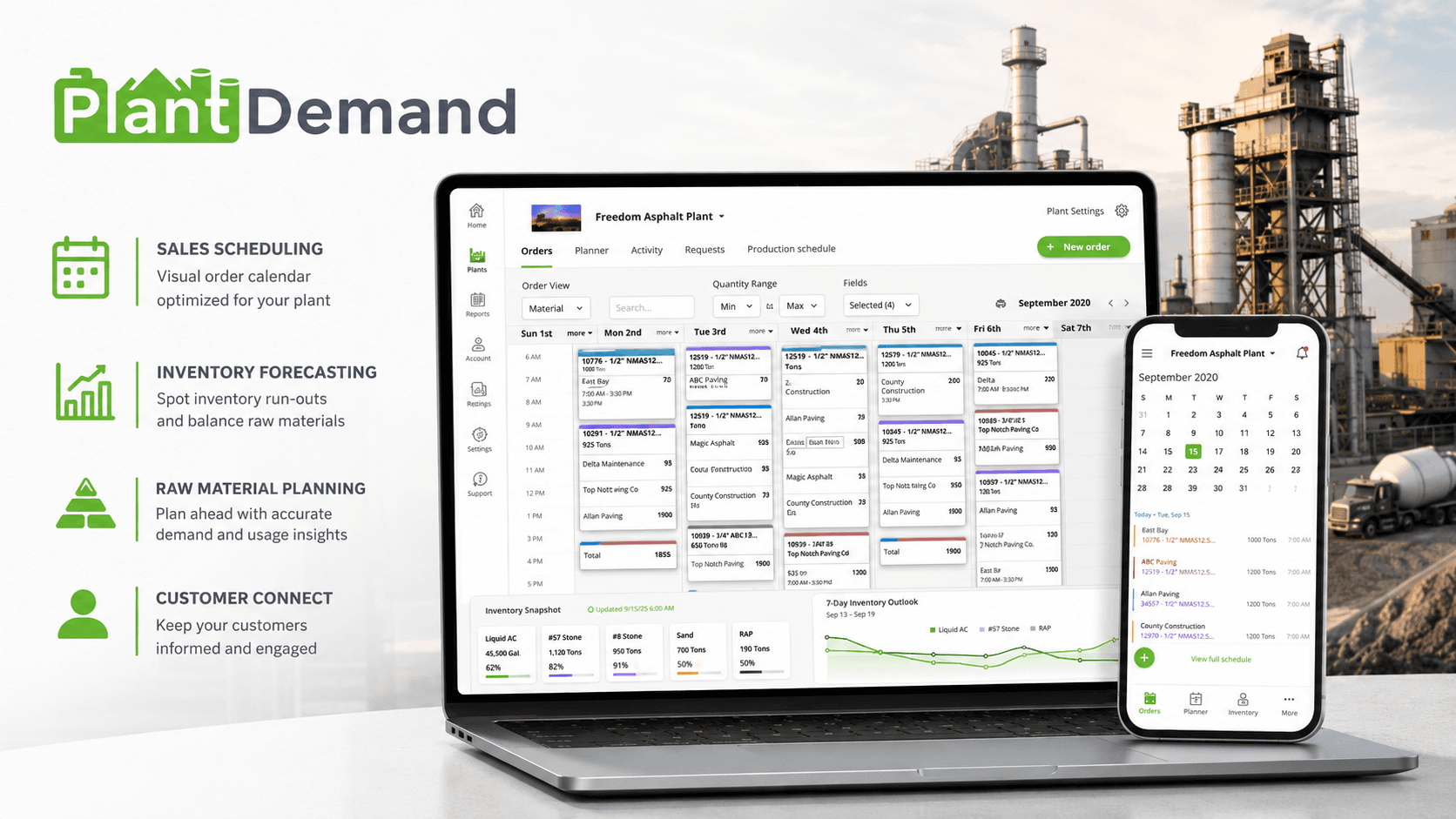
From customer inquiries to order confirmation, production scheduling, loading and shipping, and raw material replenishment, this article explains how PlantDemand helps asphalt plants connect demand visualization, capacity commitments, and material forecasting.
Starting from the complete workflow—from customer inquiries to order confirmation, production scheduling, loading and shipping, and raw material replenishment—PlantDemand’s value lies not merely in moving sales scheduling online, but in helping asphalt plants establish a collaborative mechanism centered on “demand visualization, capacity commitment, and material forecasting.” Sales plans traditionally managed through Excel, phone calls, WeChat groups, and individual experience often suffer from information lag due to customer rush orders, project delays, mix ratio changes, weather fluctuations, and inventory volatility. PlantDemand, however, uses a shared real-time calendar to bring sales, production, scheduling, procurement, and management into a single operational view, enabling order demand, production capacity, and material readiness to be identified in advance, dynamically adjusted, and rapidly synchronized.
At the sales scheduling level, PlantDemand helps asphalt plants transition from “passive order acceptance” to “proactive capacity-based commitments.” Sales personnel no longer merely record how many tons a customer needs and when they need it; instead, they can assess whether a specific time slot has available capacity by considering the day’s production line load, mix types, loading pace, customer priority, and existing order arrangements. For the production team, the order calendar provides a clear picture of future demand: peak periods, mix types requiring continuous production, and orders at risk of conflict can all be identified in advance during the scheduling phase. This allows asphalt plants to reduce redundant communication, avoid overselling capacity, and enhance the reliability of delivery commitments to customers.
At the raw material planning level, PlantDemand’s value is particularly evident in “translating sales plans into material requirements.” Once orders for the coming days or weeks are structured and consolidated, the asphalt plant can break down the sales volume by mix design into specific raw material requirements, such as aggregates, bituminous binder, RAP, mineral powder, and additives. Procurement and yard management no longer rely solely on inventory balances for ad-hoc replenishment; instead, they can identify potential shortages, stockpiles, or supply fluctuations in advance by integrating confirmed orders, forecast demand, and production rhythms. Public materials from PlantDemand also emphasize that its scheduling and forecasting capabilities can be used for inventory management, prevention of material shortages, and alignment of procurement needs with production plans.
The core significance of such systems is to establish a closed-loop digital language within the asphalt plant that spans “orders—capacity—materials—delivery.” Sales sees available production windows, production sees actionable daily tasks, procurement sees material curves that can be prepared in advance, and management sees operational risks and profit opportunities for the coming days. When the same schedule is shared across different roles, order changes are no longer just information for the sales department, and material shortages are no longer just pressure for the procurement department; instead, they become operational signals that the entire plant can respond to collectively.
In terms of implementation, we recommend that asphalt plants start with high-frequency, essential, and low-resistance sales scheduling: standardize order fields, customer information, project timelines, mix types, planned tonnage, and loading methods. Then, link scheduling data with mix designs, inventory, and supplier replenishment plans to generate rolling material demand forecasts. Key KPIs can be evaluated based on scheduling accuracy, instances of over-scheduling, downtime due to material shortages, inventory turnover, the proportion of ad-hoc procurement, on-time delivery rates, and tonnage fulfillment rates. As data continues to accumulate, PlantDemand will evolve from a mere scheduling tool into the operational hub that connects sales growth, production stability, and material cost control for asphalt plants.